Draw Action: Freestyle Fight
- 4.3
- Rating
- 50.00M
- Installs
- Free
- Price
 Analysis by App-foxy
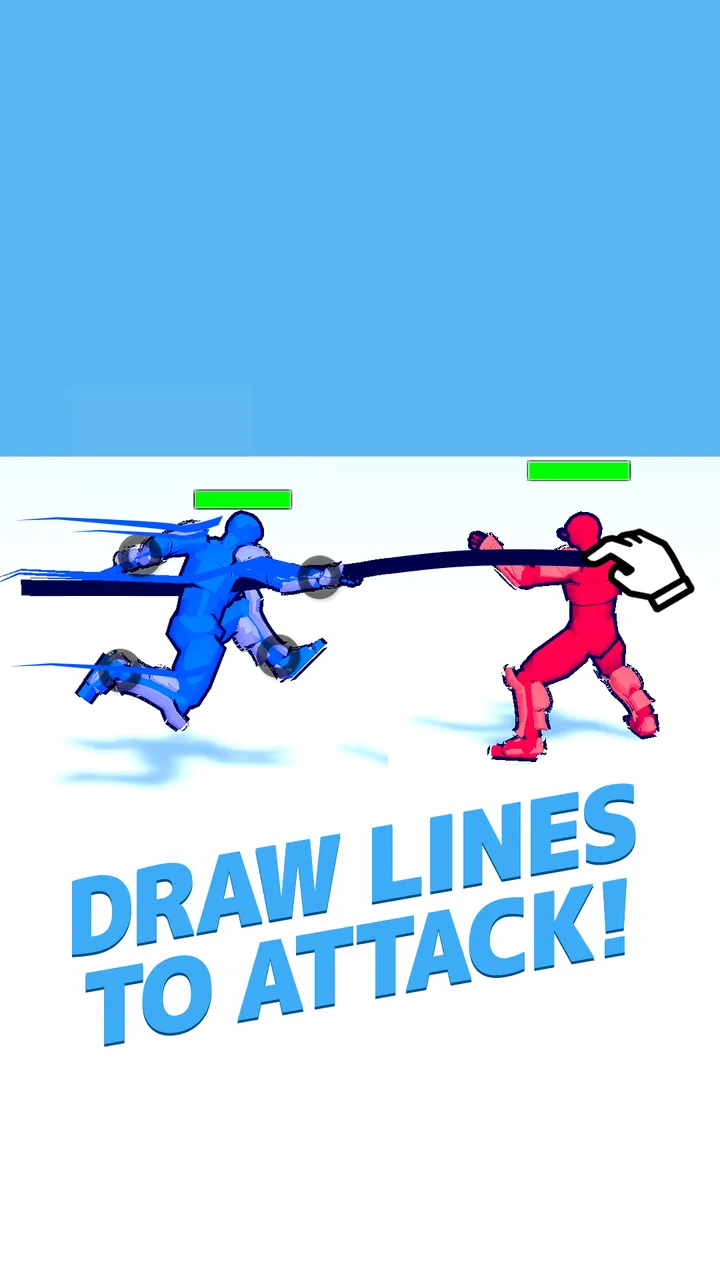
Draw Action: Freestyle Fight is the kind of action game I open when I want something immediate rather than a long campaign or a complicated control scheme. Its central idea is simple: I draw lines on the screen, and those lines become the action used to defeat enemies. That sounds basic, but the appeal comes from deciding quickly how to turn a blank space into an attack.
After spending time with it, I found that the game works best in short sessions. It asks me to look at a situation, choose a direction, and commit to a drawing instead of juggling a large set of buttons. That makes it approachable for casual players while still giving each encounter a small tactical question: what line will solve this problem most efficiently?
Developed by KAYAC Inc., this free action game is aimed at Everyone 10+. It has reached over 50 million installs and holds a 4.4 average from around 115 thousand ratings, which matches my impression that its format is easy to understand at a glance. The current version is 3.0.2, and it runs on Android 6.0 or later. Those details make it a broadly accessible choice, but accessibility is not the same as depth, so the important question is whether the drawing mechanic keeps earning your attention.
You May Also Like

 Blood Strike: 2.5 Anniversary
Blood Strike’s Loadouts Turn Every Drop Into a Tactical Gamble
A close look at Blood Strike’s custom loadouts: how fast access to signature weapons reshapes its battle royale rhythm, rewards preparation, and narrows the gap between fights.

 Pandora - Music & Podcasts
Pandora’s Music Is Easy to Start, but Harder to Recover
Pandora’s strength is its low-effort path from a seed to a station. Its weak spot is how much confidence it asks you to place in connection, setup, and quiet recovery.

 8 Ball Pool
 Is Built on Rivalries, Rematches, and Routine
A close look at the rivalries, rematches, shared routines, and unanswered safety questions that turn a quick pool match into a persistent mobile community.

 Samsung Music
’s Quiet Strength Is Playing What You Already Own
Its reach comes less from spectacle than from dependable access to a personal library. That simplicity is both the app’s strongest retention engine and its ceiling.

 AccuWeather: Weather Radar
AccuWeather Review: A Quick, Clear Forecast for Everyday Decisions
For everyday plans, the best forecast is the one you can understand quickly. AccuWeather makes rain timing, radar, and local conditions easy to act on, with a few trade-offs.

 Hill Climb Racing
Why Hill Climb Racing Still Turns Crashes Into One More Run
A tiny car, a bumpy hill and one more upgrade: Hill Climb Racing keeps resurfacing because its simple chaos makes every near-miss feel personal.
More From Our News Desk



How the first goals make the drawing mechanic click
The opening appeal is immediate because there is no long explanation to absorb before doing something. I draw a line and watch it become the solution to the enemy in front of me. That direct connection between gesture and result is the strongest part of the experience. It gives the first encounters a clear purpose: learn what kinds of lines work, understand how much freedom the drawing space allows, and become comfortable acting without traditional attack buttons.
I like that the early objective is not merely to tap an attack icon repeatedly. The shape I make matters to the moment, even when the basic idea remains easy to grasp. A short session can therefore feel more active than a typical casual action game, because my hand is creating the move instead of only selecting it from a menu.
The early goals are also useful as a test of patience. If you enjoy experimenting with gestures and seeing how a simple drawing changes the outcome, the game gives you a reason to continue. If you prefer carefully explained mechanics, character builds, or a story-led opening, this may feel too spare. The game puts its faith in the gesture itself rather than surrounding it with a large amount of narrative context.
One practical tip is to avoid treating every drawing as a frantic scribble. I had better results when I paused for a moment to read the enemy’s position, then made a deliberate line. That small habit turns the opening from a novelty into a lightweight action puzzle. The game is at its most satisfying when I feel that the result came from my choice of movement, not from drawing as quickly as possible.
Why the first few encounters are more revealing than they look
The apparent simplicity hides a useful distinction between recognition and execution. First I need to understand what the enemy situation is asking for; then I need to express that answer with my finger. Those are separate skills, and the game introduces them together without making the control scheme feel technical.
This is especially convenient when I have only a few minutes. I can start playing without remembering a complicated loadout or rebuilding a character from an earlier session. The immediate loop is the point: observe, draw, resolve the encounter, and move forward. For a phone game, that low preparation cost is a genuine strength.
There is a trade-off, though. Players who expect a broad action system may quickly ask what else they can master beyond drawing the right response. The game’s identity is concentrated in one interaction, so its success depends heavily on how well the situations keep that interaction interesting. It is not the right pick if variety means a large collection of weapons, elaborate combos, or deep role-playing decisions to you.
Progress signals and the feeling of moving forward
A good casual action game needs to show progress clearly, even when each session is short. Here, the immediate signal is whether my drawing solves the encounter and lets me continue. That feedback is easy to read, and it prevents the basic loop from becoming confusing. I know when the line worked, when it did not, and when I need to adjust my approach.
The game’s appeal is less about building a long-term identity and more about improving my own handling of the mechanic. I notice progress when I stop wasting movements, read situations faster, and draw with more confidence. That is a modest form of advancement, but it suits a game built around quick actions rather than a large management layer.
For me, the most useful progress signal is the shrinking gap between seeing a problem and knowing what to draw. At first, I approached each enemy as a new surprise. With practice, I began to recognize the kind of response the situation demanded. That recognition makes later play feel smoother, even when the game is still asking for the same fundamental gesture.
Players looking for explicit unlock trees or a strong collection system should set their expectations carefully. The verified store information presents the game as a drawing-focused action experience, and that is how I think it should be judged. I would not choose it specifically for a deep progression framework. I choose it for the satisfaction of making cleaner decisions than I did during the previous session.
Small improvements that make sessions more satisfying
I found that changing my personal goal helped keep the game fresh. Instead of only asking whether I had won, I paid attention to whether I could solve a situation with less hesitation or a more controlled line. This creates an extra layer of challenge without pretending that the game is a full competitive action system.
Another useful approach is to play in focused bursts. Because the core interaction is so direct, extended play can make the drawing feel repetitive if I continue after my attention has dropped. Short sessions preserve the sense of experimentation. I would rather stop after a satisfying run and return later than turn the gesture into background tapping.
This also answers an everyday use case. If I am waiting for a bus, taking a short break, or looking for something to occupy a few spare minutes, the game is easy to enter because the objective is immediately visible. It does not demand the same mental setup as a large strategy game. On the other hand, if I have a free evening and want a substantial adventure, I would pick a different category entirely.
Difficulty, pacing, and where the challenge comes from
The challenge curve is tied to how much pressure the game puts on my drawing decisions. The controls are friendly, but friendly controls do not remove the need to react correctly. A line that looks reasonable in isolation may be poorly timed or poorly aimed for the situation on screen. That tension gives the simple premise enough friction to support repeated attempts.
I appreciated that the challenge is personal as well as mechanical. Some players will naturally draw with confidence, while others may overthink every movement. The game rewards a balance between observation and speed. Drawing too cautiously can make the action feel slow; drawing without reading the scene can make mistakes feel avoidable.
The pacing works best when encounters arrive quickly enough to maintain momentum but still leave room for a decision. If I am in the right mood, that rhythm creates a pleasant flow: I see the threat, form a response, and immediately receive feedback. The game does not need a complicated combat interface to create that moment of pressure.
Its limitation is that the same focused design can make the experience feel narrow. Once I understand the basic relationship between lines and attacks, the novelty depends on the situations continuing to test that relationship in meaningful ways. Players who need constant mechanical expansion may find the pacing less compelling over time. I would recommend it more strongly to people who enjoy refining one unusual control idea than to players who measure depth by the number of systems available.
When the game feels fair and when it can feel demanding
The game feels fairest when I can identify why a drawing failed. That clarity matters because a gesture-based action game should make improvement feel possible. When I understand that I reacted too quickly, chose the wrong direction, or failed to read the enemy properly, retrying has a purpose.
It can feel more demanding when I treat the screen like a place for random experimentation. The drawing mechanic invites improvisation, but improvisation still benefits from attention. My best advice is to watch first, then draw. That sounds obvious, yet it changes the experience substantially: the game becomes a compact decision exercise rather than a test of how fast I can move my finger.
This is also why I would not automatically recommend it to very young children despite its accessible presentation. Its content rating is Everyone 10+, and the action framing may be more suitable for players who can follow the situation and understand that the gesture is part of the challenge. For older children, teens, and adults who enjoy quick touch-based play, the entry barrier is low.
What keeps the loop engaging, and what may push players away
Retention comes mainly from the desire to get better at the central action. I often felt tempted to try again not because I needed a lengthy reward structure, but because I believed I could handle the next situation more cleanly. That kind of motivation is immediate and easy to understand.
The free price also makes experimentation straightforward. I can try the game without treating it as a major purchase decision, which suits its short-session format. Still, free access alone cannot carry a game indefinitely. The lasting value depends on whether the drawing challenges continue to feel distinct enough to justify another attempt.
There is a clear audience split here. Someone who enjoys arcade-style repetition, fast feedback, and unusual touch controls may find the loop pleasantly addictive. Someone who needs a story, a persistent character, or a large sense of world-building may feel that the game ends at the gesture. Neither reaction is wrong; they reflect different expectations from an action game.
I would also avoid comparing it too directly with traditional action games. A button-based fighter or a larger action adventure usually offers more predictable controls, more established combat vocabulary, and often more long-term structure. This game competes on immediacy and physical input instead. Its advantage is that drawing feels personal and playful; its weakness is that the single idea has less room to expand than a broader combat system.
Who should install it and who should skip it
I would recommend it to a player who wants a quick action game with a distinctive control method, especially someone who likes testing small improvements from one attempt to the next. It is also a good fit for people who find standard virtual buttons uncomfortable or dull and would rather interact directly with the screen.
I would suggest skipping it if your priority is deep customization, a long narrative campaign, or a complex multiplayer-style competitive structure. The game’s strength is concentration, not scale. It is better understood as a focused drawing challenge with action energy than as a replacement for a full console-style combat game.
It is worth remembering that a 4.4 average from roughly 115 thousand ratings and more than 50 million installs indicates broad interest, but popularity does not guarantee that its narrow loop will suit everyone. I see those figures as a reason to try it, not as proof that it will become a permanent favorite. The best test is whether the first few encounters make you want to improve your next line.
My verdict on its progression and staying power
Draw Action: Freestyle Fight succeeds because it makes the player’s gesture the main event. The early goals are clear, the feedback is immediate, and the challenge grows from learning to read situations rather than memorizing a complicated control layout. I found that progress felt most meaningful when I became more decisive and economical with my drawings.
Its retention pressure is also its main weakness. The game can encourage repeated attempts, but the appeal is concentrated in one mechanic. If that mechanic does not keep surprising you, there may be little else to pull you back. I would not describe this as a major flaw; it is the natural cost of a deliberately focused design.
For a free action title from KAYAC Inc., it offers a clear reason to play and a low barrier to entry. The current 3.0.2 version supports a wide range of Android devices because the minimum requirement is Android 6.0, and the Everyone 10+ rating makes its audience fairly broad. Those practical details reinforce its role as an easy game to keep available for short breaks.
My final recommendation is to try it when you want a compact action challenge built around drawing, not when you want a complete combat world. I would keep it installed for quick sessions, especially when I want something more interactive than passive scrolling. Its progression is convincing as personal improvement, its pacing is strongest in short bursts, and its honest limitation is that the same focused idea may not satisfy players searching for extensive unlocks or a larger adventure.
FAQs for Draw Action: Freestyle Fight
01What is Draw Action: Freestyle Fight?
Draw Action: Freestyle Fight is a dynamic mobile game that combines elements of action and creativity. Players engage in freestyle combat by sketching their own moves, allowing for a personalized fighting experience. With a variety of characters and environments, the game offers a unique blend of strategy and artistic expression.
02How do the drawing mechanics work in the game?
In Draw Action: Freestyle Fight, players use their fingers to draw attack patterns on the screen. These patterns translate into moves that their character executes in combat. The game’s intuitive system recognizes different shapes, allowing for varied and complex maneuvers. This feature adds depth and personalization to each fight.
03Is Draw Action: Freestyle Fight suitable for all ages?
The game is designed to be accessible to a wide range of players, but it’s recommended for ages 12 and up due to its mild violence and strategic complexity. Parents should consider the game’s content and the individual maturity of younger players when determining suitability.
04What are the main features of the game?
Draw Action: Freestyle Fight offers a variety of features including customizable characters, multiple game modes, and a wide range of environments. The drawing mechanic allows for creative freedom, while the multiplayer mode encourages competitive play. Regular updates introduce new challenges and content to keep the experience fresh.
05Does the game support multiplayer modes?
Yes, Draw Action: Freestyle Fight includes both local and online multiplayer modes. Players can compete against friends or challenge opponents worldwide. The multiplayer feature enhances the replayability and excitement, allowing players to test their skills and creativity against others in real-time combat.
Pros
- Intuitive controls for seamless gameplay.
- Vibrant graphics enhance the visual appeal.
- Variety of weapons keeps combat exciting.
- Smooth performance with minimal lag.
- Multiplayer mode for added excitement.
Cons
- In-app purchases can get expensive.
- Limited storyline depth for solo play.
- Occasional ads disrupt gaming flow.
- High battery consumption during play.
- Requires constant internet connection.

Draw Action: Freestyle Fight
Gallery